A month already? A full month since my last post? Wow...well, what can I say. To try to write as much as I can is as hard as to try to eat as little as I can. Ha ha ha. See? They're both troubles to me. Eating and writing. But those trouble I adore, and adore will I be unto them.
Lots of things changed this month. No, between 9th July and 10th August. Firstly, I moved to a place closer to campus. I left my old house with a scar as big as the scratch on my fridge that those two movers did while lifting it. Damn I love my white fridge! Oh, sorry, I digress. Sometimes.
Secondly, living closer to the campus (or may I say, smacked right in the middle of KL city chaos), I feel a little different. Ok. No. Big major Big Ben Clock Tower different. THAT big, ok? Mostly, the azan sounds a bit farther in the distance here, even though we have two mosques. One attached to UM, the other one near TNB building.
I have to say this. The first thing that I look for when I move in to a new place is whether the call of prayer (azzan) is audible. Why? I hate having to turn on my laptop whenever I want to hear the muezzin calling us all to pray. So far, I have to like, really really pay attention, then only I will hear the azzan clearly. Never mind, at least it's audible.
What I like the most about this new place is that I can reach the campus in 15mins. 10 mins if I can find the taxi waiting in front of the building!
Whatever it is, I feel glad that I am now just a stone's throw from campus. Compared to the house in Kota Damansara, it takes exactly 1 hour to get to the campus, minus waiting time!
So yeah, I'm glad. And today I went to the faculty office with a heavy heart, only to return with giddy feelings! First of all, I manage to get a letter which is really important for my study leave. Next, the nice Kak Suri at the office gladly printed my PSD* form of which I thought I could never get it settled today! Then, while the Deputy Dean of Research Dr Jawakhir signing my form, she suddenly called out from her office (I was at a settee near her office door) "You're really good aren't you? You took three hardcore papers, and you managed to get As on all of them". I feel it's quite rude to speak without facing her, so I went to her office.
Me: Yes Dr?
DJ: I said your exam result is very good. Why don't you join us?
Me: Join you, Dr? But I'm bounded by the government scholarship.
DJ: That's what I'm saying. Why don't you leave the scholarship and come work with us. We could use a good generation of staffs like you.
Me: Well, to tell you the truth I have this oath I made a few years back, to give my service to UniSZA for 4-5 years, as a gift for changing my life when I did my diploma.
DJ: Well, I'm saying that you have a choice here. You can come and join us.
Now what do you say to that kind of offer? ME? I feel great. GREAT. I feel appreciated. I feel like those times I studied while having dizzy head because of the medication I ha d to swallow paid it all. I feel the effort of my mother spending a week sleeping on the floor of the UM Medical Centre was not wasted. I feel...calm.
I don't know where I get the will, but I do know that all the hardships will pay off someday. About the offer, well, I am still undecided. I want to stay loyal to my oath. Let's see. After 4 years paying off my duty for 2 years of study leave, I will take a leap, to see the world outside. To stay true to my profession.
Wish me well, dear friends.
* an academic performance form you must fill in for the purpose of tracking your performance while study leave, to be submitted to the Ministry of Higher Education
Wednesday, August 10, 2011

Saturday, July 9, 2011
The men of Terengganu
When I was a young girl, there was this man, whom we called “Ppok”, or simply “Pakcik” in standard Malay. “Ppok” could also well be a term of endearment towards father, as that is how I addressed my father, but that’s another story. If you have several uncles, you could call them all Pok – Pok Long, Pok Ngoh, Pok Su, Pok Chik, Pok De, and the list goes on. Pok could also be the term of addressing taxi driver or bus driver as I sometimes do, even until now, “Pok, bereti kat sejid puteh deh (Sir, please stop at the White Mosque)".
This ppok that I am talking about was neither my uncle or a taxi or a bus driver. According to my mother, Ppok is my grandmother’s youngest brother, hence he is my great uncle (a discovery I just made about a few minutes ago through a quick phone call). He was also well-known among the villagers and relatives as Pak Ghani or more accurately in Terengganuspeak, Pok Ghoning.
I don’t know if it’s just me or if this happens to other people, but I have very little knowledge of the whos and hows or connection among my relatives. I know their faces and names and probably their children’s names but often I got confused because relatives from both my late maternal grandmother and grandfather all resides or used to reside in Kampong Mengabang Telipot, Kuala Terengganu.
Anyways, let’s get back to my story. I remember Ppok Ghoning as a bulky man about my height, dark skinned, always walking around in white or beige Arabian jubah or robe with turban neatly rolled up on his head, probably a habit he picked up after coming back from performing hajj many, many years ago. Because ppok lived in Ngabang Tlipot and we live in Seberang Takir, we didn’t always meet, and in the many occasions I got to see him, they’re among the happiest childhood memories I have.
Among the things that I remember most about Ppok is his smile, and how he would always give me a hug, a really big bear hug every time I met him. And every time he did, he would say “bbesor doh mung!”. The fact that I have always been the giant in the family didn’t occur to him as his gesture means more of “Look at you! You’ve grown so much!” instead of “You’ve grown so big!” I still remember the musky scent that was probably a mix of minyak attar and rokok daun (a hand-made cigarette, where tobacco is filled in a rolled up dried palm tree leaves) .
When I was in standard 4, my mother and I, Ppok, Ppok’s son Pok Ali and his family went on a trip to Langkawi Island together in Pok Ali’s Vanette van. Of course we had to take the ferry at Kuala Kedah so Pok Ali’s van was parked there for a few days until we returned from Langkawi. Actually the trip was more like a visit to Ppok’s daughter who was working in Langkawi at that time.
Ppok, being an old man and a real Terengganu men at that, made a lot of memorable things, at least to me, during the trip.
One of the many things that happened in the van was Ppok’s many doings which forced us to ride in the van with the air condition turned off and the van window wide opened. Ppok is a man who cannot live without his rokok daun, hence once in an hour we would have to suffer while he puffed nonchalantly. And at other times, we not only have to breathe the rokok daun smoke, but also him having to pass motion once in a while!
Once we reached Langkawi, it was already night and we went straight to bed. The next morning, we woke up and found out Ppok left the house. I was wondering where he went and after about an hour he was back. You see, Ppok lived by the rule that going to the beach every morning is a ritual. Everyone asked where he went and he said “Aku gi berok ppata!” (I went to do my business in the beach!).
Now, if you are older than me and if you live by the beach, do not tell me that you have never heard about the story how the people who live in the beachside area sometimes do their business by the beach, and how the waves that landed on the beach would swoosh away their “remainings”. After the trip, should anyone ever mention Langkawi Island to Ppok, he would proudly say “Langkawi? Tepak aku berok!” (Langkawi? It was where I did my business!)
For a girl who grew up without a father, Ppok is a significant character in my life, a character that sometimes made me long for the presence of my own father. It was by fate that I did not grow up with my father but every God’s doing is fair. He took away my father but he gave me Ppok who had brightened up my childhood.
So when one day in July 1999 we received the call from his daughter, saying that Ppok has left us forever, I felt like there was a big hole in my heart. Ppok was found lying down in the beach near his house, with his hypertension pills scattered around his foot. He probably had an episode during his ritual morning beach-walking and was trying to pop the pills into his mouth when fate decided that we should no longer receive his bear hug anymore.
This ppok that I am talking about was neither my uncle or a taxi or a bus driver. According to my mother, Ppok is my grandmother’s youngest brother, hence he is my great uncle (a discovery I just made about a few minutes ago through a quick phone call). He was also well-known among the villagers and relatives as Pak Ghani or more accurately in Terengganuspeak, Pok Ghoning.
I don’t know if it’s just me or if this happens to other people, but I have very little knowledge of the whos and hows or connection among my relatives. I know their faces and names and probably their children’s names but often I got confused because relatives from both my late maternal grandmother and grandfather all resides or used to reside in Kampong Mengabang Telipot, Kuala Terengganu.
Anyways, let’s get back to my story. I remember Ppok Ghoning as a bulky man about my height, dark skinned, always walking around in white or beige Arabian jubah or robe with turban neatly rolled up on his head, probably a habit he picked up after coming back from performing hajj many, many years ago. Because ppok lived in Ngabang Tlipot and we live in Seberang Takir, we didn’t always meet, and in the many occasions I got to see him, they’re among the happiest childhood memories I have.
Among the things that I remember most about Ppok is his smile, and how he would always give me a hug, a really big bear hug every time I met him. And every time he did, he would say “bbesor doh mung!”. The fact that I have always been the giant in the family didn’t occur to him as his gesture means more of “Look at you! You’ve grown so much!” instead of “You’ve grown so big!” I still remember the musky scent that was probably a mix of minyak attar and rokok daun (a hand-made cigarette, where tobacco is filled in a rolled up dried palm tree leaves) .
When I was in standard 4, my mother and I, Ppok, Ppok’s son Pok Ali and his family went on a trip to Langkawi Island together in Pok Ali’s Vanette van. Of course we had to take the ferry at Kuala Kedah so Pok Ali’s van was parked there for a few days until we returned from Langkawi. Actually the trip was more like a visit to Ppok’s daughter who was working in Langkawi at that time.
Ppok, being an old man and a real Terengganu men at that, made a lot of memorable things, at least to me, during the trip.
One of the many things that happened in the van was Ppok’s many doings which forced us to ride in the van with the air condition turned off and the van window wide opened. Ppok is a man who cannot live without his rokok daun, hence once in an hour we would have to suffer while he puffed nonchalantly. And at other times, we not only have to breathe the rokok daun smoke, but also him having to pass motion once in a while!
Once we reached Langkawi, it was already night and we went straight to bed. The next morning, we woke up and found out Ppok left the house. I was wondering where he went and after about an hour he was back. You see, Ppok lived by the rule that going to the beach every morning is a ritual. Everyone asked where he went and he said “Aku gi berok ppata!” (I went to do my business in the beach!).
Now, if you are older than me and if you live by the beach, do not tell me that you have never heard about the story how the people who live in the beachside area sometimes do their business by the beach, and how the waves that landed on the beach would swoosh away their “remainings”. After the trip, should anyone ever mention Langkawi Island to Ppok, he would proudly say “Langkawi? Tepak aku berok!” (Langkawi? It was where I did my business!)
For a girl who grew up without a father, Ppok is a significant character in my life, a character that sometimes made me long for the presence of my own father. It was by fate that I did not grow up with my father but every God’s doing is fair. He took away my father but he gave me Ppok who had brightened up my childhood.
So when one day in July 1999 we received the call from his daughter, saying that Ppok has left us forever, I felt like there was a big hole in my heart. Ppok was found lying down in the beach near his house, with his hypertension pills scattered around his foot. He probably had an episode during his ritual morning beach-walking and was trying to pop the pills into his mouth when fate decided that we should no longer receive his bear hug anymore.
To my dear Ppok, Al-Fatihah.
*The title reads “Men of Terengganu”. I wanted to write more of the Men, but I’m sorry I have to clear these dusts in my eyes. Please excuse me while I go blow my nose.
Wednesday, July 6, 2011
Budu in USA
There’s a story about this guy who used to be the parliament member of our kampong, who went to the US of A in the 80’s (I could only guess) to further his study. This story was told in many occasions where he would tell people about the shortcomings he had to go through when he furthered his study in a foreign land. Here it goes.
A young man, of about 18 excelled in his SPM (or was it MCE) examination. He went to further his study in the USA in the 80’s (it could be 70’s, I’m not so sure). He went there alone, and as at that time there weren’t many people from Terengganu who had the chance to further their studies abroad, he found himself alone in the streets after getting off the airplane.
There he was, walking with his heavy luggage, probably filled with clothes that no one in the US of A would wear, and maybe belacan seketul dua (just play along with me on this OK?), and suddenly a car honked at him from behind. He was shocked! This was his first day in this foreign country and he was already honked at!
He turned around, and he felt a little bit apprehensive, and he barely saw the driver. Because his knowledge of English was so scarce, he didn’t dare say anything, fearing that his mother tongue dialect would interfere. Suddenly, the driver called out...
“Budu?”
“Budu!”
The young man smiled. He found a little comfort in this foreign land at last.
-END-
Tuesday, July 5, 2011
From Blog to Book
When I first read Growing Up in Terengganu, written by Awang Goneng or the man behind the pseudonym, Wan Hulaimi, I felt a sting in my throat. Sure, there were times when the book managed to make me laugh out loud especially when he mentioned how Cik Wook Payong Loccoh got her name, but when I arrived at the last page, I found myself asking the question “Wasn’t I supposed to do something after reading this book?”
Well, there are several things I could do. First I can shut the book and forget about it. After all, it is just a book, a recollection of someone else’s childhood memory. Second, I could go on a raging mad protest, standing under the hot sun in front of the once there old buildings along Jalan Banggol that were demolished to give way to newer, modern skyscrapers in Kuala Terengganu, but I’ll burn my skin and in the quiet, almost uneventful Kuala Terengganu, it would be too much.
Or, my other option, I could start writing about my own experience of living in Kuala Terengganu. I could write about things I love, what my family members do, what my mom cooks, what the folks in the kampong street in front of my house talks about when they are out on the gerre [pangkin in standard Malay] during one of the many hot nights in Seberang Takir, and since I tend to be forgetful of things [blame the journals I’m reading for my thesis], this might be a good way of making sure that someday I can look back at what I wrote and rekindle those memories.
This post was started about a month ago but it stays as a draft as I find it difficult to sit down and sit, unlike few years back where I would just sit and think of a topic and bam! – I’ve got a new post in my blog.
I went back to my hometown a few days ago, and upon arriving at the KT Bus Terminal, I had this strange, elated feeling of taking the pencil out from my backpack and start to write. I will post what I feel that morning in another entry. For now, here are the photos taken at Awang Goneng’s book signing event of his second book, A Map of Trengganu which happens about zillions of years ago (see the point of exaggeration? That’s how much I feel glad of being able to write again) at Borders, The Gardens, Midvalley. I met many interesting people at that event.

Awang Goneng in his own element.

Almost a full house!

Pak Usman Awang, who said that the turnovers for the event is considered quite big for a Malaysian writer.

Tea break provided by Wau Penyu, in which the owners are Kelantanese wife and Terengganu husband, hence the name "Wau Penyu". Nice "akok".
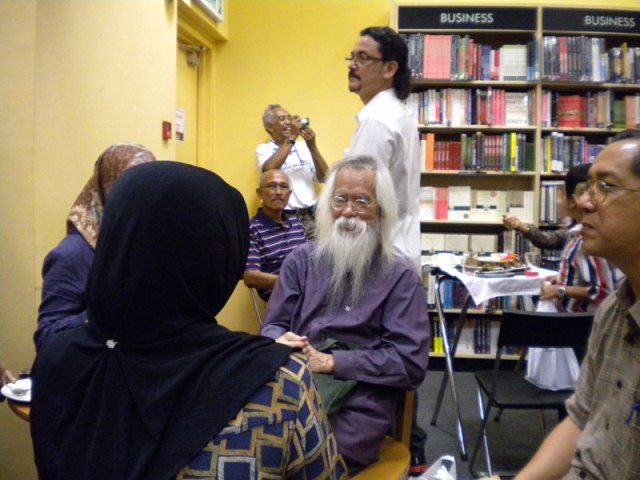
I think many people had fun talking to each other in a relaxing manner, and despite Mr Wan Hulaimi being so busy that he didn't even get to sit and finish his keropok, everyone else had a good time.

Awang Goneng and his plate of unfinished keropok.

Adik Ahmad Ali Karim, a very very young blog writer. You can find his blog here.

Uncle Lee reminiscing his younger years in London when he studied Law and met Awang Goneng at Malaysia Hall. Next to him is Pakcik Bustamann the owner of the blog "Di bawah rang ikang kering"

People talking, eating, standing, having fun.

More people.
I had a great day. I feel that it is quite joyous to see people coming, giving support to this writer who wrote in detail about his happy childhood memory. I too, would like to be able to do that someday, to write about my own memory of living in Terengganu, as Awang Goneng did when he lived in Trengganu.
Tuesday, June 28, 2011
trying to force your brain to come up with something to write is tiring
sekian topik saya.
hari ni birthday saya. 28 years old (or young, depends on whether you see the glass half-full or half-empty :P) . sila wish kalau anda manusia yang baik hati.
i think i know why i have no idea to write about Terengganu. it's because i'm NOT in Terengganu.
So i'm going back on 29th. we'll see what happens. da!
hari ni birthday saya. 28 years old (or young, depends on whether you see the glass half-full or half-empty :P) . sila wish kalau anda manusia yang baik hati.
i think i know why i have no idea to write about Terengganu. it's because i'm NOT in Terengganu.
So i'm going back on 29th. we'll see what happens. da!
Saturday, May 14, 2011
Of me and budu
 Image credit here.
Me and budu, we’ve come a long way. Way back when I was in primary school, living with both my grandfather Bak [now arwah] and step-grandmother Tok Pi, of whose name comes from the abbreviation of her name, Rafiah. She now lives in Pekan, Pahang but that’s another story.
Now to get this story started, I’d like to make one thing clear. I don’t eat budu. Call me nebbeng or do’oh lalu but I could never, intentionally, take the budu bottle and sprinkle a few dashes on my piping hot rice, or pour a few spoonfuls of budu in a mangkok and mix with lada jarung [bird’s eye chillies] which are khennyet [crushed] and sprinkled with some lime juices.
When I was in primary school, I once went home and found myself surrounded by budu smell. Strong, foul smell of pickled anchovies that now filled the whole area of my home. Now home at this time was my Bak’s house, situated a few meters away from the famous Terengganu poet’s house, J.M. Aziz. The home was a place where I grew up as a child, tough child I would say as my mother worked as a tailor at shop rows in Steseng Bah Kuala Terengganu from 7am to 7pm, when the Bah Meroh would pull over at the street in Kampung Baru, sending home the kampong people who worked in bbando [town].
By now I almost died. I can’t eat budu, worst still I can’t even stand the smell. I hurriedly climbed the stairs, changed my school uniform as fast as I can, and avoided at all cost to go to the kitchen, where it smelled the worst. I ran to my aunt’s house, Mok Ting, and told her of the budu smell. She told me that now that my Bak has closed his small grocery shop by the main road in Kampong Baru, they [my grandfather and step-grandmother] have decided to take the job of filling the budu into small bottles and later selling them.
I figured it didn’t pay much, but as my Bak was not someone who would just lazy around all day long, he needed to do something. Anyways, it was not a day-job. They only need to fill the budu into the bottles – the size of coca-cola glass bottles – about twice a month. So for the next few years of my life, well into my secondary school years, I would have to come face to face with the smell of one delicacy that I loathe wholeheartedly. So much for a budu seller’s granddaughter.
It’s not the taste that makes me steer away from budu, but it was the smell. I’m not sure how budu is made, but I’m pretty sure that the combination of all the ingredients makes it addictive. I mean, one of my nieces would not eat anything without budu, as I once saw her poured budu into a bowl of mi rebus [yellow noodle with black pepper-infused broth]!
To smell budu, of which to other people is as tantalizing as the taste of budu itself, is so foul to me, and everyone in the family knows how much I loathe the smell that whenever we gathered at the dining table, no one dared to put the mangkok budu in front of me. They would put it far away from me, and I would endure the smell of the budu while everyone dips their ikang kembung panggang or goreng [grilled or friend mackerel] in the budu mix.
I am the only one in the family, or probably the whole Kampong Baru Seberang Takir who do not eat budu, I think. However, I do believe that somehow, I must have accidentally taken budu in several occurrences in my life, especially when my mom cooked Bubur Lambuk or Sayur Labu, a dish made with labu air or bottle gourd cooked in simple watery black pepper broth, mixed with shredded pieces of ikang selayang.
I remember once while eating the sayur labu, I told my mother sternly to not to put any budu in my dishes. Proud as I sounded, I am the youngest daughter in the family and being the closest to mother, of course she would listen to me – or so I thought. And I was saying this while having the sayur labu with hot rice, ikang kembung goreng [fried mackerel seasoned with blended red chilli paste, salt and turmeric powder] and sambal belacan, or belacang as we Terengganu people call it. My eldest sister Kak Long was there, and she was about to say something when I noticed my mother nudged her. I think she was about to say “But there was budu in the sayur labu!”.
Later, I think a few years later, I managed to confirm my curiosity when one day I asked my mother how to cook sayur labu, and as she was telling me the ingredients, she slipped the word “budu”, and I went “Doh selame ni massok sayur labu mok memang letok budu ah?” ["So all this while you've been adding budu into the bottle gourd dish?] to which she replied, “Ho lah, dok letok budu dok jjadi sayur labu lah. Bubur lambuk ggitu gok. Kalu dok letok budu, dok rase lah ikang dalang bubur tu” ["Of course. If there is no budu in the dish, then it will not be called as the bottle gourd dish. So does bubur lambuk. If there is no budu in the bubur lambuk, then the fishy taste will not be that good].
Duped for life, that’s how my history with budu is.
Like I said in the beginning, me and budu, we’ve come a long way. No matter how much I try to avoid eating budu, it will always linger silently in the background, waiting for the right moment to jump into the dishes that I eat.
Now to get this story started, I’d like to make one thing clear. I don’t eat budu. Call me nebbeng or do’oh lalu but I could never, intentionally, take the budu bottle and sprinkle a few dashes on my piping hot rice, or pour a few spoonfuls of budu in a mangkok and mix with lada jarung [bird’s eye chillies] which are khennyet [crushed] and sprinkled with some lime juices.
When I was in primary school, I once went home and found myself surrounded by budu smell. Strong, foul smell of pickled anchovies that now filled the whole area of my home. Now home at this time was my Bak’s house, situated a few meters away from the famous Terengganu poet’s house, J.M. Aziz. The home was a place where I grew up as a child, tough child I would say as my mother worked as a tailor at shop rows in Steseng Bah Kuala Terengganu from 7am to 7pm, when the Bah Meroh would pull over at the street in Kampung Baru, sending home the kampong people who worked in bbando [town].
By now I almost died. I can’t eat budu, worst still I can’t even stand the smell. I hurriedly climbed the stairs, changed my school uniform as fast as I can, and avoided at all cost to go to the kitchen, where it smelled the worst. I ran to my aunt’s house, Mok Ting, and told her of the budu smell. She told me that now that my Bak has closed his small grocery shop by the main road in Kampong Baru, they [my grandfather and step-grandmother] have decided to take the job of filling the budu into small bottles and later selling them.
I figured it didn’t pay much, but as my Bak was not someone who would just lazy around all day long, he needed to do something. Anyways, it was not a day-job. They only need to fill the budu into the bottles – the size of coca-cola glass bottles – about twice a month. So for the next few years of my life, well into my secondary school years, I would have to come face to face with the smell of one delicacy that I loathe wholeheartedly. So much for a budu seller’s granddaughter.
It’s not the taste that makes me steer away from budu, but it was the smell. I’m not sure how budu is made, but I’m pretty sure that the combination of all the ingredients makes it addictive. I mean, one of my nieces would not eat anything without budu, as I once saw her poured budu into a bowl of mi rebus [yellow noodle with black pepper-infused broth]!
To smell budu, of which to other people is as tantalizing as the taste of budu itself, is so foul to me, and everyone in the family knows how much I loathe the smell that whenever we gathered at the dining table, no one dared to put the mangkok budu in front of me. They would put it far away from me, and I would endure the smell of the budu while everyone dips their ikang kembung panggang or goreng [grilled or friend mackerel] in the budu mix.
I am the only one in the family, or probably the whole Kampong Baru Seberang Takir who do not eat budu, I think. However, I do believe that somehow, I must have accidentally taken budu in several occurrences in my life, especially when my mom cooked Bubur Lambuk or Sayur Labu, a dish made with labu air or bottle gourd cooked in simple watery black pepper broth, mixed with shredded pieces of ikang selayang.
I remember once while eating the sayur labu, I told my mother sternly to not to put any budu in my dishes. Proud as I sounded, I am the youngest daughter in the family and being the closest to mother, of course she would listen to me – or so I thought. And I was saying this while having the sayur labu with hot rice, ikang kembung goreng [fried mackerel seasoned with blended red chilli paste, salt and turmeric powder] and sambal belacan, or belacang as we Terengganu people call it. My eldest sister Kak Long was there, and she was about to say something when I noticed my mother nudged her. I think she was about to say “But there was budu in the sayur labu!”.
Later, I think a few years later, I managed to confirm my curiosity when one day I asked my mother how to cook sayur labu, and as she was telling me the ingredients, she slipped the word “budu”, and I went “Doh selame ni massok sayur labu mok memang letok budu ah?” ["So all this while you've been adding budu into the bottle gourd dish?] to which she replied, “Ho lah, dok letok budu dok jjadi sayur labu lah. Bubur lambuk ggitu gok. Kalu dok letok budu, dok rase lah ikang dalang bubur tu” ["Of course. If there is no budu in the dish, then it will not be called as the bottle gourd dish. So does bubur lambuk. If there is no budu in the bubur lambuk, then the fishy taste will not be that good].
Duped for life, that’s how my history with budu is.
Like I said in the beginning, me and budu, we’ve come a long way. No matter how much I try to avoid eating budu, it will always linger silently in the background, waiting for the right moment to jump into the dishes that I eat.
Monday, May 9, 2011
When The Sky Is Different Blue
 The first view of the sky that I enjoy every morning, right in front of my house
When I was a young girl, I used to go to the beach when the sun was right up on my head - yep, my rendezvous with the beach in Kampung Telaga Daing started after Zuhur and ended at Asar. Why after Zuhur? The answer is - at 1pm, the beach was scorching hot, so no one was at the beach, perfect for me. I would sit under one of the makeshift tents/teduhan [I'll verify the name of that thing with my mom later] which were made of four bamboo poles, thrust into the sand as far as the fisherman's hand can in the shape of a square, and on top of the poles, coconut leaves - few branches of them - were neatly tied to the pole with tali ropia, colorful strings made with very very thin plastic. And the floor of the makeshift tent? Nothing but sands.
 The sky in Merchang, on my way back from Dungun to KT
 Pantai Tok Jembal, taken during my niece's wedding photo shoot.
 Dataran Pulau Kambing at Maghrib. I had Ramadhan Iftar on one of the many benches here.
I remember the beach at that time as a place to clear my thoughts. Growing up with a single parent was never easy, and often I escaped to the beach. I didn't do much. I didn't play with the sand, I didn't take a dip in the saltwater; all I did was to look up to the sky, and nothing else. Of course the calming sound of the wave was there - it was like a background music to my sky-admiring activity.
 Even though things have changed with the land, the sky remains faithfully blue as ever
 The sky in Pantai Teluk Ketapang, in one of its many calm afternoons, where you will see
various shapes of kites flown by the kids [or sometimes, adult!]
I remember vividly, how the blue sky accompanied the ever-changing clouds chased by the wind, how the color was blue, so blue that it was indescribable with my limited vocabulary at that time [I found out later that we use the word "azure" to describe the blue sky, which I don't agree because how can you describe the color with just one word?]. Anyways, I just sat there, cloud-watching till I heard Asar azan, or call of prayer from the nearby Surau Kampung Telaga Daing. Then I would leave the beach, feeling a lot lighter and calmer.
 Sometimes, the sky turns nasty, between July - January
[picture taken at Jambatan Sultan Mahmud]
 But I see some kites flying so obviously we're not scared of it.
 Stock your food, fix your leaking roof. Monsoon is here everyone.
My fascination with the sky in Terengganu doesn't stop there. When I did my diploma in KUSZA, I told my friend something that she laughed about. It's probably because of the way I said it. I told her "Do you know why I love Terengganu? It's the sky. Even the sky is different blue in Terengganu". For an 18-year-old, you don't say that to your girl friend, or you risk being labeled "melancholic". I didn't care. Later when she finished her diploma and left Terengganu, I think she agrees with me. Nobody knows.
 Teluk Ketapang
 The serene, untouched beach at Kampung Mengabang Telipot. Right in front of these trees is my mother's cousin's kedai borong, Kedai Haji Karim. Cheapest in town!
The secret love affair was further justified when I bought a digital camera. Finally I have a tool to capture all those lovely skies. It is just a small Nikon camera, priced under RM1000, but it was enough to state my love for the blue sky. I started capturing photos of the sky every time I went out to the beach. Now I can remember how it looks like. When I am old and not able to go to the beach anymore, I can look at the photos and instantly, the sounds of the waves that accompany me when I was admiring the sky returns. I can almost feel the burning sun on my tanned skin every time I thought of the sky.

Pantai Teluk Ketapang at dusk
I think it's the color of the sea. I think that's what makes Terengganu sky very different from other states. I've lived in Tanjong Malim for four years when I did my first degree, and I have never seen the sky as blue as the ones in Terengganu. I used to sit at the window of my hostel room, and wonder why don't they have blue sky, because that's what I do when I'm stressed. Oh well, jogging in the unpaved road surrounded by palm trees wasn't such a bad idea to unwind.

Whatever makes the sky blue, I am thankful that it is still as blue as it was years ago. No matter what was done to the sand below the sky, it stays the same. So I was not kidding when I said this once and I would say it again, "Even the sky is different blue in Terengganu".

Now everyone knows how much I love Pantai Teluk Ketapang
Whatever makes the sky blue, I am thankful that it is still as blue as it was years ago. No matter what was done to the sand below the sky, it stays the same. So I was not kidding when I said this once and I would say it again, "Even the sky is different blue in Terengganu".
 One of the many boats docked at Marina Bay Resort, Pulau Duyung
*All photos are writer's own. Please credit accordingly if you would like to use them. Thank you.
Subscribe to:
Posts (Atom)